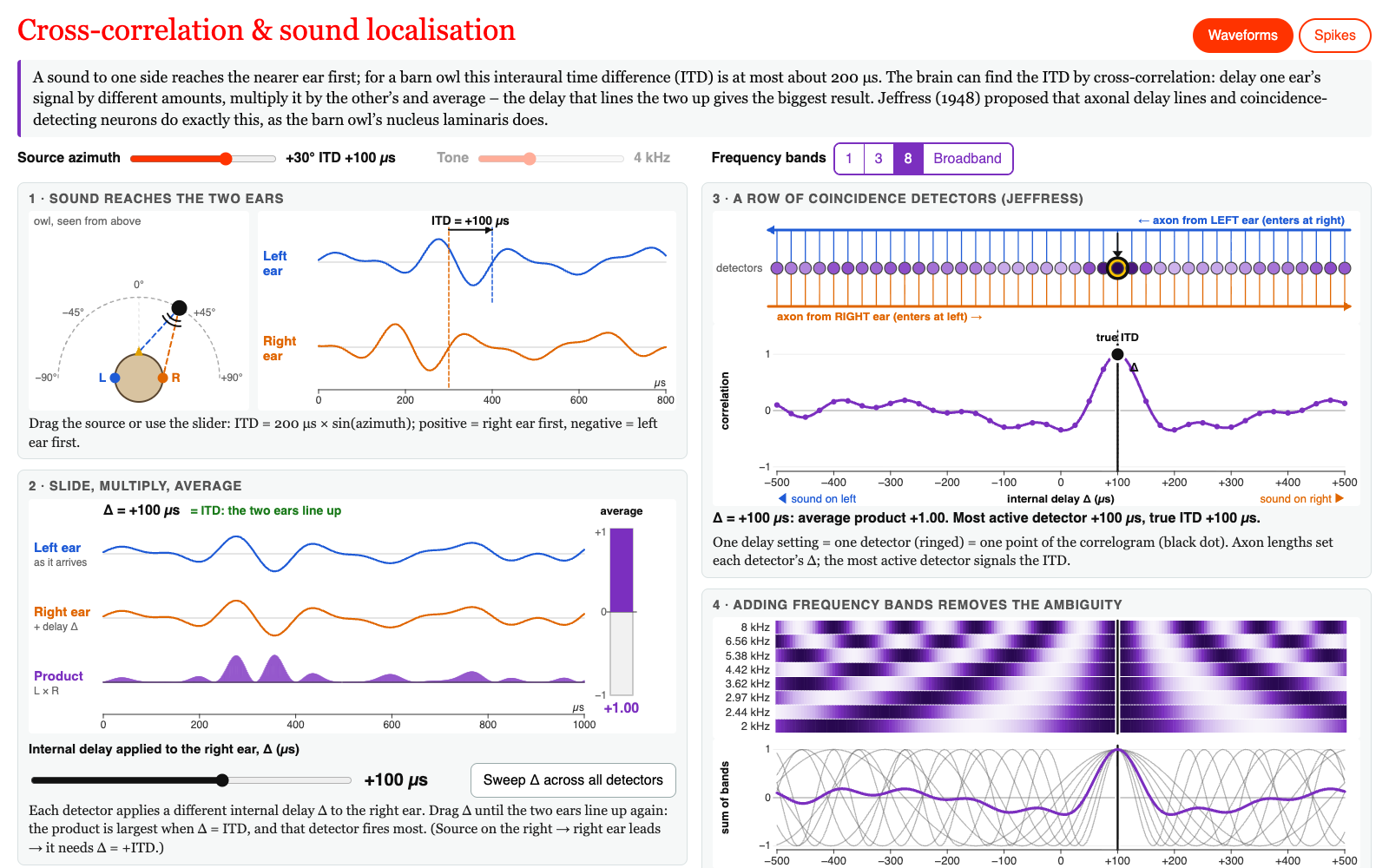
An interactive demonstration for the NEUR0016 lecture Temporal processing in audition. Move a sound source around an owl-like head (interaural time difference up to about 200 µs) and watch the brain’s cross-correlation at work: one ear’s signal slides past the other’s, the two are multiplied and averaged, and a row of Jeffress-style coincidence detectors, each with a different internal delay, lights up to build the cross-correlogram. With a single tone the correlogram has several equal peaks, 1/f apart; adding frequency bands makes the true peak stand out as the side peaks cancel. A spikes mode replaces the waveforms with noisy, phase-locked spike trains and counts coincidences, as in the barn owl’s nucleus laminaris.
Download the demo (single HTML file, works offline) and open it in any web browser.
The demo runs entirely in your web browser; nothing is installed and no data is sent to a server.